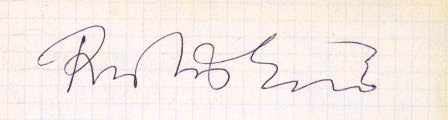
This
is a copy of Ernö Rubik's signature as it appears in my notebook. He
signed it at the World Championship in Budapest in 1982
-http://www.ws.binghamton.edu/fridrich/cube.html-
My beSt RegaRds....:granick:..

Step One: Solving the Top Layer
Place the Remaining Top Row Corners

Since we have solved the first corner of our top row when we primed
it, we are now ready to solve the other three. To do so, you must turn
the entire cube (and we mean the whole thing, not any rows, columns or
faces) to the left so that your original corner cubie is now the
upper-left-hand corner on the front of the cube. In our example, you
can see that the upper-left-hand corner is now the original
blue-red-white corner with the blue and red facelets showing on the
graphic (since we turned the entire cube to the left). We now need to
solve the upper-right-hand corner again, so we must figure out which
corner to put there. In fact, this is quite easy. Since the mystery
cubie must have blue on it (otherwise it won't match the rest of the
top color), and it must also have red on it (or it won't make a
full-red side with the first red facelet there), we simply must find
the other corner on the cube with blue and red on it. On our cube, this would be the Blue-Red-Yellow cubie.
The next step is to maneuver this target cubie to the
bottom-right-hand corner of the cube (shown here in black to help
demonstrate the target location). The blue, red and yellow facelets on
this cubie can be in any order and on any side as long as the cubie is
in its proper spot. Simply turn the bottom row around (without
disturbing the top row) until your target cubie is in its place. Once
the cubie is at the bottom-right-hand corner on the front, depending on
the location of the top color (Blue) we will choose one of the
following algorithms to move it up to the top-right-hand corner and
flip it around to line it up properly.
           |
For example, if our Blue-Red-Yellow cubie happens to have
the blue facelet showing on the right side of the cube (position 1) we
would use the first algorithm. If instead it was on the front side
(position 2) we would use the second algorithm. Finally, if the Blue
facelet is on the bottom of the cubie (position 3, indicated by the
hand pointing to the bottom) you would use the third algorithm. It may
also happen that the target Blue-Red-Yellow Cubie is already in its
proper top-row position (also shown in black for targeting purposes)
but it is not facing the right way (the red facelet is not on the same
side as the original red facelet). If the Blue facelet is on the front
(position 4) use the fourth algorithm, and of course if it is on the
right side of the cubie (position 5) use the fifth algorithm. If you
want to, you may also start in the other direction, as long as you keep
in mind the goal of finishing the top corners to all have the same top
color and matching side facelets. If your desired cubie is trapped in
the middle layer, simply skip to another corner and once you solve it
the target cubie will have been forced in the top or bottom row. When
you are finished with the corners, your cube should look like the
mini-cube shown at the top of this step, with a Blue "X" on the top of
the cube and all the other corner colors matching up horizontally with
their partners. Now we're ready to complete the top layer by finishing
the edges.

Step Two: Solving the Top Layer
Place All of the Top Edges and Finish the Top

Now that we know the general ideas on how to find the proper target
cubie and then move it into position, we're ready to finish the top
layer. Keeping the above concepts in mind, we must now find the target
edge cubies (those that will complete the top row) and move them into
the new target positions, again colored black here. Simply turn the
bottom and middle layers until the target cubie is in one of these
spots, and based on which side the top color (blue) is on, select from
the following algorithms to move it into its place. When you are
finished with step two, the entire top layer of the cube should be
solved as shown on the mini-cube at the beginning of this step.
    |

Step Three: Solving the Middle Layer
Align the Centers and Place All of the Edges

To begin step 3, you must first turn the middle layer around so
that the center cubies in the middle layer all match with their top
layer counterparts. In our example, you can see that the red center and
yellow center match up with their respective colors above them. This is
known as forming the Half-T. Once you have the centers aligned, you are
will have already partially solved the middle layer. The only thing
left to do will be to place the remaining edges.
Now, turning only the bottom row, we will position the
target cubie so that it will match up with its same-color center
forming the Full-T. In our example, we have turned the bottom row
around so that we have formed a Full Red T on the front of the cube. We
may be ready to place this cube into position, but we must first check
to make sure it is indeed the correct edge. On our cube, we would need
the bottom of the Red T cubie to be either Yellow (which when moved to
the right would match up with the Red and Yellow centers) or the
Red-White cubie (which on our cube could be moved left, matching up
with the Red and White centers). If this edge cannot connect either of
the two centers to the left or right, or it is upside down (there is
not a T formed, the Red facelet is improperly on the bottom, etc.) you
must move on to another center. There will almost always be another T
immediately possible, and after you have placed the correct edge you
can move on to the next one. If you find that no T is possible, or that
the correct edge is in the proper position but is turned around so that
the colors do not match up, simply place a random cubie into its place
by performing either of the algorithms below. This will force the
proper cubie back to the bottom. Occasionally, you will have to do this
several times to get the positioning correct. When you have finished,
your cube should look like the mini-cube at the beginning of this step
with both the top and middle layers fully solved. Here are the
algorithms you will use to move the target cubie to either the right or
to the left.
| Right Left   |

Step Four: Solving the Last Layer
Turn the Cube Over and Arrange the Corners

Now you'll turn the entire cube upside down (so the completely
finished Blue top becomes the bottom) and arrange the last unfinished
layer (Green) corners into their correct positions, although not yet finished. On our cube, the front face is the red side. So the
correct corners for the front side (labeled as 1 and 2) must both have
Green and Red facelets on them. Using this logic, the back side of our
cube is Orange so the back corners (labeled as 3 and 4) must both then
contain Green and Orange facelets. Furthermore, all the final corners
must also be on their correct sides. For example, on our cube the Green-Red-White corner must be in position 1 and the Green-Red-Yellow
corner must be in position 2. Once we are ready to flip them over in
the next step they must match up with all three colors (the top and the
two sides) to be finished. To arrange the corners into their correct
positions, we may have to utilize the following repositioning
maneuvers:
Switch 1 and 2   Switch 1 and 3 |
Many times you can take a look around the cube and see
that you can simply turn only the unfinished top row around and find
the two Red corners and Orange corners in their desired positions
(without disturbing the two finished layers of course). Once you get
the two red (or orange) corners side-by-side, you may then find that
they will have to be switched so that they'll be on their proper sides.
To do this, you will perform the "Switch One and Two" maneuver.
Concerning the Orange corners, you must turn the entire cube around
(not moving any rows or columns) so that the Orange side is now the
front. Then you can perform the switching maneuver as needed. If two
Reds are diagonal from one another (the red corners are currently at
positions 2 and 3), perform the "Switch One and Three" maneuver to
bring them side-by-side. When you have finished this step, your cube
will have the corners arranged to their proper positions, but probably
not yet finished.

Step Five: Solving the Last Layer
Completely Finishing the Last Layer Corners

In this step, we will flip all of the last layer corners around
into their final finished positions. On our cube, Green is the last
layer color. To solve the corners, we will focus on three different
configurations concerning the Green facelets. Using the graphic to the
left, hold your cube so that when you are looking at the front you have
any of these Green facelet configurations exactly as shown. For this
step, none of the other remaining facelets (or the rest of the cube)
matter so they are not shown, including any other Green facelets on the
last layer.
You should always be able to find one of the three
arrangements on your cube, and once you do you will perform the
following algorithm. You may have to perform this algorithm several
times, each time making sure to find the proper configuration of Green
facelets, and you'll need to use at least two of the three different configurations to
continue (don't try just finding the same configuration over and over
again or you'll just get stuck). If you could not find one of the
starting configurations when you started this step, simply perform the
algorithm once, and then you'll be able to find one of them.
| Several times |


Step Six: Solving the Last Layer
Finish Two Edges and Prepare the Remaining Two

You should now find that you have also placed at least one of the
remaining last layer edges into its final position, although not
necessarily turned around correctly. Turn the entire cube around so
that the side with a correctly positoned edge is now the front (in some
cases, you'll have a couple to choose from). In our diagram, the side
with the Green-White edge is the front because the edge is in its
proper place (just needing to be flipped over). Then perform the
following repositioning algorithm to move the rest of the edges into
their proper places (up to two times). If you couldn't find a correctly
positioned edge to start with, perform the algorithm once and then
proceed as usual.
| From the Correctly-Positioned Corner Side |

Step Seven: Finish the Rubiks Cube Solution
Finish the Final Two Edges and Solve the Rubiks Cube

We are now ready to completely solve the Rubik's cube. At this
point, only the last unfinished layer concerns us so the rest of the
cube is not shown. In almost all cases, there will be two edges
completely solved, after finishing step six above, and two edges
unsolved. The two unsolved edges, however, are now properly positioned
on their correct sides and simply need to be turned around to be
solved. Turn the entire cube (not any rows, columns or faces) around
until the last two unsolved edges match up to either of the graphics
shown to the left when looking at the front of the cube. In the graphic
the completely solved cubies of the last layer are shown in Pink, and
the two unsolved edges are shown in Purple.
Once you are ready, perform the applicable last layer
algorithm below to completely solve the cube. The first is known as the
"H" Pattern, and the second is known as the "Fish Pattern". If for some
reason you had all four edges flipped (instead of the usual two edges)
when you finished step six, simply perform the "H" Pattern once from
any front. You will then be able to find either of the two original
patterns at that point. Congratulations! You've solved the Rubiks Cube!
| Dedmore H Dedmore Fish |
--
..:granick:..
Step One: Solving the Top Layer
Place the Remaining Top Row Corners
Since we have solved the first corner of our top row when we primed
it, we are now ready to solve the other three. To do so, you must turn
the entire cube (and we mean the whole thing, not any rows, columns or
faces) to the left so that your original corner cubie is now the
upper-left-hand corner on the front of the cube. In our example, you
can see that the upper-left-hand corner is now the original
blue-red-white corner with the blue and red facelets showing on the
graphic (since we turned the entire cube to the left). We now need to
solve the upper-right-hand corner again, so we must figure out which
corner to put there. In fact, this is quite easy. Since the mystery
cubie must have blue on it (otherwise it won't match the rest of the
top color), and it must also have red on it (or it won't make a
full-red side with the first red facelet there), we simply must find
the other corner on the cube with blue and red on it. On our cube, this would be the Blue-Red-Yellow cubie.
The next step is to maneuver this target cubie to the
bottom-right-hand corner of the cube (shown here in black to help
demonstrate the target location). The blue, red and yellow facelets on
this cubie can be in any order and on any side as long as the cubie is
in its proper spot. Simply turn the bottom row around (without
disturbing the top row) until your target cubie is in its place. Once
the cubie is at the bottom-right-hand corner on the front, depending on
the location of the top color (Blue) we will choose one of the
following algorithms to move it up to the top-right-hand corner and
flip it around to line it up properly.
| |
For example, if our Blue-Red-Yellow cubie happens to have
the blue facelet showing on the right side of the cube (position 1) we
would use the first algorithm. If instead it was on the front side
(position 2) we would use the second algorithm. Finally, if the Blue
facelet is on the bottom of the cubie (position 3, indicated by the
hand pointing to the bottom) you would use the third algorithm. It may
also happen that the target Blue-Red-Yellow Cubie is already in its
proper top-row position (also shown in black for targeting purposes)
but it is not facing the right way (the red facelet is not on the same
side as the original red facelet). If the Blue facelet is on the front
(position 4) use the fourth algorithm, and of course if it is on the
right side of the cubie (position 5) use the fifth algorithm. If you
want to, you may also start in the other direction, as long as you keep
in mind the goal of finishing the top corners to all have the same top
color and matching side facelets. If your desired cubie is trapped in
the middle layer, simply skip to another corner and once you solve it
the target cubie will have been forced in the top or bottom row. When
you are finished with the corners, your cube should look like the
mini-cube shown at the top of this step, with a Blue "X" on the top of
the cube and all the other corner colors matching up horizontally with
their partners. Now we're ready to complete the top layer by finishing
the edges.
Step Two: Solving the Top Layer
Place All of the Top Edges and Finish the Top
Now that we know the general ideas on how to find the proper target
cubie and then move it into position, we're ready to finish the top
layer. Keeping the above concepts in mind, we must now find the target
edge cubies (those that will complete the top row) and move them into
the new target positions, again colored black here. Simply turn the
bottom and middle layers until the target cubie is in one of these
spots, and based on which side the top color (blue) is on, select from
the following algorithms to move it into its place. When you are
finished with step two, the entire top layer of the cube should be
solved as shown on the mini-cube at the beginning of this step.
| |
Step Three: Solving the Middle Layer
Align the Centers and Place All of the Edges
To begin step 3, you must first turn the middle layer around so
that the center cubies in the middle layer all match with their top
layer counterparts. In our example, you can see that the red center and
yellow center match up with their respective colors above them. This is
known as forming the Half-T. Once you have the centers aligned, you are
will have already partially solved the middle layer. The only thing
left to do will be to place the remaining edges.
Now, turning only the bottom row, we will position the
target cubie so that it will match up with its same-color center
forming the Full-T. In our example, we have turned the bottom row
around so that we have formed a Full Red T on the front of the cube. We
may be ready to place this cube into position, but we must first check
to make sure it is indeed the correct edge. On our cube, we would need
the bottom of the Red T cubie to be either Yellow (which when moved to
the right would match up with the Red and Yellow centers) or the
Red-White cubie (which on our cube could be moved left, matching up
with the Red and White centers). If this edge cannot connect either of
the two centers to the left or right, or it is upside down (there is
not a T formed, the Red facelet is improperly on the bottom, etc.) you
must move on to another center. There will almost always be another T
immediately possible, and after you have placed the correct edge you
can move on to the next one. If you find that no T is possible, or that
the correct edge is in the proper position but is turned around so that
the colors do not match up, simply place a random cubie into its place
by performing either of the algorithms below. This will force the
proper cubie back to the bottom. Occasionally, you will have to do this
several times to get the positioning correct. When you have finished,
your cube should look like the mini-cube at the beginning of this step
with both the top and middle layers fully solved. Here are the
algorithms you will use to move the target cubie to either the right or
to the left.
| Right Left |
Step Four: Solving the Last Layer
Turn the Cube Over and Arrange the Corners
Now you'll turn the entire cube upside down (so the completely
finished Blue top becomes the bottom) and arrange the last unfinished
layer (Green) corners into their correct positions, although not yet finished. On our cube, the front face is the red side. So the
correct corners for the front side (labeled as 1 and 2) must both have
Green and Red facelets on them. Using this logic, the back side of our
cube is Orange so the back corners (labeled as 3 and 4) must both then
contain Green and Orange facelets. Furthermore, all the final corners
must also be on their correct sides. For example, on our cube the Green-Red-White corner must be in position 1 and the Green-Red-Yellow
corner must be in position 2. Once we are ready to flip them over in
the next step they must match up with all three colors (the top and the
two sides) to be finished. To arrange the corners into their correct
positions, we may have to utilize the following repositioning
maneuvers:
| Switch 1 and 2 Switch 1 and 3 |
Many times you can take a look around the cube and see
that you can simply turn only the unfinished top row around and find
the two Red corners and Orange corners in their desired positions
(without disturbing the two finished layers of course). Once you get
the two red (or orange) corners side-by-side, you may then find that
they will have to be switched so that they'll be on their proper sides.
To do this, you will perform the "Switch One and Two" maneuver.
Concerning the Orange corners, you must turn the entire cube around
(not moving any rows or columns) so that the Orange side is now the
front. Then you can perform the switching maneuver as needed. If two
Reds are diagonal from one another (the red corners are currently at
positions 2 and 3), perform the "Switch One and Three" maneuver to
bring them side-by-side. When you have finished this step, your cube
will have the corners arranged to their proper positions, but probably
not yet finished.
Step Five: Solving the Last Layer
Completely Finishing the Last Layer Corners
In this step, we will flip all of the last layer corners around
into their final finished positions. On our cube, Green is the last
layer color. To solve the corners, we will focus on three different
configurations concerning the Green facelets. Using the graphic to the
left, hold your cube so that when you are looking at the front you have
any of these Green facelet configurations exactly as shown. For this
step, none of the other remaining facelets (or the rest of the cube)
matter so they are not shown, including any other Green facelets on the
last layer.
You should always be able to find one of the three
arrangements on your cube, and once you do you will perform the
following algorithm. You may have to perform this algorithm several
times, each time making sure to find the proper configuration of Green
facelets, and you'll need to use at least two of the three different configurations to
continue (don't try just finding the same configuration over and over
again or you'll just get stuck). If you could not find one of the
starting configurations when you started this step, simply perform the
algorithm once, and then you'll be able to find one of them.
| Several times |
Step Six: Solving the Last Layer
Finish Two Edges and Prepare the Remaining Two
You should now find that you have also placed at least one of the
remaining last layer edges into its final position, although not
necessarily turned around correctly. Turn the entire cube around so
that the side with a correctly positoned edge is now the front (in some
cases, you'll have a couple to choose from). In our diagram, the side
with the Green-White edge is the front because the edge is in its
proper place (just needing to be flipped over). Then perform the
following repositioning algorithm to move the rest of the edges into
their proper places (up to two times). If you couldn't find a correctly
positioned edge to start with, perform the algorithm once and then
proceed as usual.
| From the Correctly-Positioned Corner Side |
Step Seven: Finish the Rubiks Cube Solution
Finish the Final Two Edges and Solve the Rubiks Cube
We are now ready to completely solve the Rubik's cube. At this
point, only the last unfinished layer concerns us so the rest of the
cube is not shown. In almost all cases, there will be two edges
completely solved, after finishing step six above, and two edges
unsolved. The two unsolved edges, however, are now properly positioned
on their correct sides and simply need to be turned around to be
solved. Turn the entire cube (not any rows, columns or faces) around
until the last two unsolved edges match up to either of the graphics
shown to the left when looking at the front of the cube. In the graphic
the completely solved cubies of the last layer are shown in Pink, and
the two unsolved edges are shown in Purple.
Once you are ready, perform the applicable last layer
algorithm below to completely solve the cube. The first is known as the
"H" Pattern, and the second is known as the "Fish Pattern". If for some
reason you had all four edges flipped (instead of the usual two edges)
when you finished step six, simply perform the "H" Pattern once from
any front. You will then be able to find either of the two original
patterns at that point. Congratulations! You've solved the Rubiks Cube!
| Dedmore H Dedmore Fish |
--
..:granick:..
Rubik's Revenge!
| Pre-Solution Stuff (4x4x4) |
Step 1 | Step 2 | Step 3 Solution Moves Lists |


The
Rubik's Revenge was a puzzle introduced in the early 80's after the big
Rubik's Cube craze. Instead of the usual 3x3x3 design the Revenge has 4
cubes on every side. This adds some interesting qualities to the cube.
On the Revenge you can switch two centers and leave the rest of the
cube solved. However on the Rubik's Cube you can't switch just two
centers, the minimum that you can switch on the Rubik's Cube is four.
You also have to not only solve the centers on a Rubik's Revenge but
you have to put them in the right spots. My method for solving the
Revenge is complete and has no holes in it so you will be able to solve
your Rubik's Revenge every time from any legal scrambled position.
In
this method I will assume that you can already solve the Rubik's Cube
(3x3x3). If you cannot solve the original Rubik's Cube then you will
only be able to half solve your Rubik's Revenge. If you need to learn
how to solve the Rubik's Cube then click here to go back to my Rubik's Cube page.
Basics
First lets get to know what the
different parts of the cube are called. One side of the cube is called
a face. There are six faces on the cube, front, back, down, up, left,
and right. The whole section that is attached to each face that you can
turn is called a slice. The Individual pieces are corners, edge pieces,
and center pieces.


Notation
In order for me to be able to
tell you specific moves to do on your cube you'll need to be able to
read what I'm saying. The notation I will be using looks like this, F f
B b L l R r U u D d. Capital letters stand for the outer faces such as
the front face, back face, down face, etc. Lower case letters stand for
the faces just behind the outer ones, such as the inner front face,
inner back face, inner down face, etc. Here are a few diagrams to show
were each face is and how each can turn. The faces turn on the dark
lines.
 |  |

When doing the moves a letter by itself means a clockwise move. R would mean to turn the right face clockwise. f would mean to turn the inner front face clockwise. R ' would mean to turn the right face counter clockwise. An appostraphy next to the letter denotes a counterclockwise turn.
R ² means to turn the right face twice, either two clockwise
turns or two counterclockwise turns, however you want to look at it.
Whenever making a move do the move as if you were looking at that face.
For example the move B ' would be done as if you were looking at the back face. The move d ' would be done as if you were looking at the down face. Here is an example of an
algorithm that I might give you.
F L ' U ² l '
Here is what you would do to your cube,

 |  |
 |  |
While going through my solution some of the diagrams may have gray areas on them, here is an example,

These
gray areas show colors that you should not be worried about in that
particular step. In this example this is a picture of how to put the
blue yellow edge piece in next to the other blue yellow edge piece in
the top face. All the gray colors are parts of the cube that don't
involve moving the blue yellow piece next to the other blue yellow
piece so they should be ignored for this step.
Step 1 | Step 2 |
Step 3
Solution Moves Lists
| Step 1: Solve all Centers |
Pre-Solution Stuff | Step 1 | Step 2 | Step 3 Solution Moves Lists |
Part 1: The
first step in solving your cube is you have to solve the centers so you
can have a point of reference for solving the rest of the cube. The
trick to this is that you have to get all the centers in the right spot
(if the centers don't correctly line up with each other then the edges
and corners won't line up either and it makes a real big mess). The
first thing you need to do is solve two opposite centers. If you know
of two colors that are opposite on your cube it makes things a little
easier. The colors that are opposite on my cube are this, in case yours
are the same, blue-white, green-yellow, red-orange. If you're not sure
of two opposite colors on your cube then here is a way to double check
to make sure you get two opposite colors. Take two corners, each with
say red and yellow in their color schemes. You can pick any two corners
but make sure each corner cublet has two colors that are the same. You
don't have to move them just look at them. Now that you have these two
cublets if you were to solve them then they would be on the same edge, only
opposite sides of that edge (i.e. one corner would touch the top face
and the other would touch the bottom face). Now just look at the other
two colors on each of those pieces and you have two opposite colors.
Here is an example to clear this up. Let's say I pick two corner
pieces, red-yellow-blue, and red-yellow-white. Now if I were to solve
these two corners then the red-yellow part would be on the same edge of
the cube. This would put them on opposite sides of that edge so that
each touched a different face (either bottom or top). Now I know that
blue and white are opposites on that particular cube because they are
on opposite sides of the cube when the corners are solved.
 |  |
Part 2:
Now that you know two opposite colors you have to solve those two
centers. Lets stick with the two opposite colors blue and white for
this example (these colors may not be opposite on your cube so if
they're aren't just use two colors that are). The first step is to make
two rows of each color. Get two pieces into this position first,

In this position do the move l to get the blue piece from the top lined up to the one on the front face.

Now to remeber where blue needs to go do the move F ² to get it into the u slice. When you have a solid row in the
u slice think of that as being set as the center color for that face. This helps to remeber where to postion the centers in relation to each other.
Now
you have to solve a white row. There are three things that can happen
from here. Either you already have a row of white centers solved, in
that case get it onto the opposite face as blue and set it (put it in
the u slice) If your cube already had a white row solved then after you set it
click here,
or you will have 2 white centers not on the back or front faces, or you
will have 3 whites on the back face, and one white not on the back or
front face.
1. If you have two white centers not in the back or front face get your cube to look like this,

From here do the move f ' to solve the white row and then d ' B ² to put it into the back face and set it.
Now you should have 2 white centers in what I call the middle section.
The middle section is all the faces except the ones where you're
solving the centers, in this case the up face, down face, left face,
and right face. If any centers are in the front or the back face then
turn the d slice to get them into the middle section. Be careful when
doing this to not turn the other white center back into the front or
back face at the same time. If it looks like that's going to happen
then move one of the whites to a face that hasn't been set with another
color, the left or right face, and do the move N ² (N being whatever
slice the piece is on) Then turn the other white into the middle
section. Now that those two centers are in the "middle section" between
the front and back faces get them into this position,
|  |
From here do the moves f ' d '. This will completely solve the white center.
Go on to #3.
2.
Now
if you only had one white center in the middle section and 3 white
centers on the back face here is what you do. First of all do the move F. This gets the blue row out of the way for a turn on the
l slice. Now get the one white piece in the middle section and
get it into the position in the diagrams. Now turn the back face to get
the 3 whites into the position on the diagram. Now do the move l. This solves the white row. Now do the moves
U ' l ' This will completely solve the white center.
 |  |
3. Now your cube should have the white center solved and a blue row on the opposite face. If it doesn't then
start over.
From here you need to solve the last blue row. There are three things
that can happen from here. You will either have the last blue row
solved but in the middle section, or you will have 2 blue center pieces
in the middle section, or you will have one blue center piece in the
middle section and one in the front face.
I. If your cube has a blue row already solved but it is in the middle section then you have to do one of two moves.
If your cube looks like this then do this move L ² d ' L ² d
. This move will put the blue row in the u face then move a white row to the opposite face of the cube, restore the blue row to the d face then solve the centers.
 |  |
If your cube looks like this then do this move
R ² d R ² d ' . This move will put the blue row in the u face then move a white row to the opposite face of the cube, restore the blue row to the d face then solve the centers.
 |  |
II. If your cube has the last two blue center pieces in the middle section then get your cube to look like this,
 |  |
From here do the move f ' L ² d ' L ² d. This will solve the blue row then move it to the
u face, move the white row to the opposite side of the cube, move the blue row back onto the d slice, then move them back in place of their centers.
III. If your cube has one blue center piece in the front face and one in the middle section then get your cube to look like this,
 |  |
From here do the move F d F ' d '. This move will solve the last blue row and then the last move restores the two centers.
Your cube should now look like this,
 |  |
4. Now
that you have the first two centers solved you have to do the other
four. For the next step blue and white become the top and bottom faces.
For these examples I'll use white as the top face and blue as the
bottom face. Now you have to solve the front and back centers. Do the
same thing you did with two corners that you did in the beginning to
find two more opposite centers on your cube. For this step you don't
need to worry about using the corners to position the centers right it
will still work out. Now that you have two more opposite colors on your
cube they become the front and back centers. For this example I'll use
green and yellow as the next opposite centers to solve.
There are 4 things that can happen at this point. Either both of these centers will be solved and in the right spot (
go to #5),
they will be solved and in the wrong spots, you will have solid rows of
each color but the centers not solved, the pieces for the centers will
be scrambled everywhere with few or no solid rows.
I.
If your cube has the centers solved but not in the right spots (not on
opposite sides of the cube) then hold your cube as in the diagram below
and do the move d ' B ² d ² L ² d '. The colors on your cube can be switched
from this diagram. Instead of having green in the front face and yellow
in the left face you can have yellow in the front face and green in the
left face. In that case do the same move it will still work.

II. If your cube has 2 rows of each color solved then get your cube to look like this
 |  |
The black dot on the U face in both diagrams is in the same spot on both diagrams it is just used to help show how the cube is oriented
From here do the move d to solve the green and yellow centers.
III.
If your cube has few or no solid rows of green or yellow then here is
what you do. First you have to set any rows that you do have. If you
have one green row and one yellow row make sure to set them on opposite
sides of the cube. Now you have to solve the remaining pieces. You do
this basically the same way you solved the blue and white rows in the
beginning, only now you do it without using the top or bottom faces.
Here is an example,

In this example you would do the move d F ' d '. This will solve the yellow row then set it in the front face. Once you have 4 rows do the same thing as in
II. to solve the centers. Here is an example for if you already have a row set

Here you would do the move d ' L d. This will solve the green row on the L
face then move it into the front face to solve the center. Just mess
around with these moves to solve the centers. Maybe you'll even come up
with a few new moves. A hint on if you have one center solved and only
one row or no rows solved of the other color. Hold that center so that
it is on the front face and blue and white are on the bottom and top
faces then do the move d ' L ² This will set one of the rows in the L face. This helps you to use the d face to help you solve the other center. Once you have two rows of each color then refer to
II. to finish the two centers. Basically you have to think in rows. Once you do have a row completed remember to put it in the u face. That way you have room to use the d face to do all your moves. I hardly every use the
u face to do the work in any of these steps. You can adjust this
to your liking but I prefer to do everything on the lower half of the
cube.
5.
Now you should have 4 centers solved. Using the corners double check to
make sure both pairs of solved centers are opposite colors. Now you
have two centers left to solve and they should be on opposite sides of
the cube. If you do not have this on your cube then go back to
whichever step best resembles your cube and try again. Now the two
unsolved faces become the front and back faces. For these examples I'm
going to use orange as the front face and red as the back face. Before
you start solving these centers you have to make sure you're solving
them into the correct face. To do this you have to solve one of the
corners that touches two of the solved centers. From here you know the
color of the face with the unsolved center. Here is an example,

Now
you would know that the dark gray area is orange and the opposite face
(the back face) is red. There are 6 positions your cube can be in now.
Either all the centers are now solved and in the right places ( Go on to step 2),
all the centers are solved but the red and orange ones are switched,
you have two solid rows of each color but they are not all on the right
face, you have a checkered pattern on both faces, you have 3 of each
color on one face and one of the other color on the same face, or you
have a checkered pattern on one face and two rows on the other.
I.
If all of your centers are solved but the red and orange ones are
switched then hold your cube so that the centers that need to be
switched are on the front and back faces like in the diagram
 |  |
From here do the move d ² r ² d ² r ² l ² d ² l ² d ². This will switch the centers by rows.
II. If your cube has a solid row of each color on both the front and back faces then get it to look like this
 |  |
From here do the move d ² B ² d ² This will solve the red and orange centers.
III. You may also have a checkered pattern of both faces like this, *NOTE* Before doing this move check to make sure that your cube looks like these diagrams. If it does not then turn only
the back and/or front faces to get it into this position.
 |  |
Now do the move d ² F B d ².
This will solve both the orange and red centers and get them in the
right place. Once again note that this move only works when your cube
is in the position of the diagrams. If the move did not work then make
sure that the centers look exactly like they do in the diagram.
IV.
If your cube has three of one color and one of the opposite color on
both the front and the back faces then there are two things that can
happen from here. You will either have three orange and one red on the
front face or three red and one orange on the front face. Basically in
this step you either have most of the front face colors on the front
face or most of the back face colors on the front face. Solve a corner
that connects the front face, left face, and right face in relation to
how you're holding the cube now. Now you know the color of the front
face.
If the three center pieces on the front are supposed to be on
the front (orange in my example) then get your cube to look like this
 |  |
From here do the move d ² F ' d ². This will make the last two rows for the centers then solve them. This will solve the red and orange centers.
If you're cube has three center pieces from the back face on the front (red in my example) then get your cube to look like this
 |  |
From here do the move d ² F ' B ² d ². This will get all the pieces into solid rows of their color then solve the centers.
V. Your cube may have a checkered pattern on one face and solid rows on the other face. If it does turn the F and/or B faces to get your cube like the diagrams, (
*NOTE* Before doing this move check to make sure that your cube looks exactly like these diagrams. If it does not then turn only the back and/or front faces to get it into this position).
|  |
Now do the move d ² B d ² B F ' d ² B ' d ². This will get the pieces into the position from number
IV
and then solve them the same way. If the move did not work then you
might not have had the pieces in the exact same spot as the diagram.
Try to find the step that most closely resembles your cube and try
again.
Overview
Now your cube should look like this,
 |  |
Now
you have solved your cube 1/3 of the way! Only 2 more steps to go!
Before going on to the next step solve one corner with it's three
centers and double check to make sure those three are on the right
spot. Then, if you know your opposite colors, you can look at the
opposite face of each of those front faces to make sure the centers are
solved. If your centers are not lined up then you're going to have a
very hard time in step 3.
| Don't forget to double check! |
 |
Pre-Solution Stuff | Step 1 | Step 2 |
Step 3
Solution Moves Lists
| Step 2: Solve all Edges |
Pre-Solution Stuff | Step 1 | Step 2 | Step 3 Solution Moves Lists |
Part 1: In
this step you're going to finish making your scrambled 4x4x4 cube into
a scrambled 3x3x3 cube. In this step you're going put all the edge
pieces next to their corresponding edge pieces and make one solid edge
group for each pair. Once you've solved all the edge groups you'll be
able to solve your cube as if it were a normal rubik's cube (3x3x3),
except for a few situations which I will tell you how to fix in step 3.
This step will not take long to explain as it is basically the same
idea done repeatedly. First you have to know what parts of the cube are
going to do what.
 |
Although
it may seem like this step is going to complicated it actually the
easiest one in my opinion. First of all here is how you should "view"
the cube when you look at it.

Any edge groups in the U or D faces you should think of as stored. In the first step when you
set a center piece row in the u slice this is the same type thing for this step. Once you solve an edge group put it into the U or D face. Once an edge is in either the U or D
face then make sure not to use it again. Once they are stored you can
just leave them alone. The stored edges are represented by the medium
dark gray in the diagram. All the dark gray edge groups are the working
edges. These are the ones that you are going to do the actual work
with. It is in this "middle section" of the d and u slices where you will solve the edge groups. Now on to the moves for solving the edges.
Part 2: Before we even start you need to store any solved edge groups that you have (put them in either the
D or U faces). Now you need to solve all the other edge
groups. Basically what you need to do is get two pieces, that are
seperated, from the same edge group and put one in the u slice and one in the
d slice and then solve them from there. The basic strategy for this step is to solve an edge group and store it in either the U or D
face. Then just pick two more edge pieces, which belong in the same
edge group, and solve them. Each time you solve an edge group and store
it then just move on to another edge group. Once you've solved all the
edges except for the four working edges you'll need to use another set
of moves to solve the last four and then you'll be ready to move on to
step 3.
1. To put a solved edge group into the D or U face there are two moves you need to know.
I.
To put a solved edge into the U face hold your cube like this,
 |
Make sure when doing this move that you have an
unsolved edge group in the same position as the dark gray edge pieces in the diagram. Now from here do the move L ' U ' L. This will move the solved edge group to the U face and then replace it with an unsolved edge group.
II. To move a solved edge group to the D face hold your cube like this,

Make sure when doing this move that you have an unsolved edge group in the same position as the dark gray edge pieces in the diagram. Now from here do the move
L D L '. This will move the solved edge group to the D face and then replace it with an unsolved edge group. The d
slice is moved a lot during this step and at times your cube will not
have the centers solved but in rows. Once you've solved all but the
working edges will you solve the centers again. Just make sure to do
the moves carefully or the rows will be split into their original
pieces and then you have to solve the centers again.
2. Your cube may have two adjacent edges in the position in the diagrams. If they are switched (The edge piece on the d slice is on the right and the piece in the
u slice is on the left) then just turn the d slice until your cube looks like the diagrams.
 |  |
From here hold the cube as in the front view diagram. Now do the move d R U ' R ' d '
. What this move does is to solve the edge group, then move it to the U
face and replace it with an unsolved edge group. Finally the last moves
restores the centers. Your cube should now look like this,
 |  |
Now
you're done with this edge group so don't even pay attention to it
anymore and move on to the next group that needs to be solved.
3. If your cube has two edge pieces spread on the diagonals of the cube then get your cube to look like the diagrams,
 |  |
While holding the cube as in the front view diagram do the move d ² R U ' R ' d ²
. This move does the same thing as the one above which is to first solve the edge group, then move it to the U face and replace it with an unsolved edge group. Then the last moves restores the centers.
4. Your cube may have two edge pieces in the same layer like this,

Your pieces may not look exactly like the diagram but if they are in the same layer, either the d or u face, then hold your cube so one of the edges is in the darker gray area on the diagram below (it will either be in the
u or d face but make sure it is still in the position of the darker gray area),

Now do the move L ' F U ' L F. This move will flip the edge group so that now the edge piece should be in the other layer. If it was in the
d slice it should now be in the u slice and vice versa. Now just do the move above that corresponds to your cube.
5. If one of the pieces you need is in the
U or D face then you need to move it to the middle
section so you can solve it. If your cube has an edge piece that you
need but it is in the D face instead of the U face then
turn your whole cube over so that it looks like one of the diagrams
below. There are two positions your cube can be in right here,
I. In this
diagram say you wanted to solve the red-white edge group. To get the
red-white piece from the top to the working area do this move R U ' R '. This will get the edge piece out of the
U face and keep the two pieces seperated between the u and d slices. Now you can solve it normally.

II. In
this diagram if I was solving the red-white piece and I did the move
above it would end up putting the red-white piece from the U face in the u face. However the other red-white edge piece is already in the u
face so you would have to flip one of the edges to be able to solve it.
To save moves just do this move while holding the cube as in the
diagram F R ' F ' R. This will put the piece in the way it needs to be to let you use the moves above to solve the edge group.

III. In the above two diagrams the edge piece that is not in the U face may be in the
d face instead of the u face. If this should happen then use one of the two moves above to get the edge piece from the U
face into the middle section. After a few times of doing these moves
you'll learn which one works for which scenario. If for any reason when
you move a piece from the top layer to the middle section and it is
flipped from the way you need it to be then do the move from #4
6. Now you should have 8 edge groups solved and spread out in the
U and D faces. These next moves will show you how to
solve the working edges. The basic strategy is to solve two of the
edges and then to use a certain move to solve the last two at the same
time. Before you do any of these moves make sure that you've solved the
centers back. Sometimes while solving the first 8 edge groups the
centers will be split apart (but only in rows if you do it right).
After you've solved the first 8 edge groups turn the d slice to fix them again. If for some reason the centers got mixed up and they aren't in rows anymore then you have to
go back to step 1 and fix them all over again :-(
I. Your cube may have two edges in this position,
 |  |
Now hold your cube as in the front view diagram and do the move d R F ' U R ' F d '
. This move will move the blue-yellow piece from the edge group on
the left over to the right, then the next few moves flips the edge
group on the right, once it is flipped the last move will restore the
centers and it will solve both edges at the same time. Now you only
have the last two edge groups to solve so go to #7.
Your cube may be in the same position as above except one of the edges is flipped like this,

From here do the
move from #4 to flip the edge on the left then solve it with the move above.
II.
Your cube may already have one of the last four edge groups solved so
that now you only have three scrambled edge groups. First you need to
pick one of the edge groups, any one of them, and choose one of the
pieces (for the move to solve the edge group both pieces need to be in
the u face so it helps to choose a piece already in the u face so you don't have to flip it). In the diagram say I chose the orange-blue piece. Now you need to find the other edge of the same color and put it in the
u slice as well (if it is in the d face just do the move from #4 to flip it). Once you've done that hold your cube as in the front/left view diagram and do the move
d ' L ' F U ' L F ' d. This will move the bottom piece from
the right side edge group over to the left and replace it with the
other blue-orange piece. The last moves solves the edge groups and
restores the centers.
 |  |
Your cube may have both pieces you chose on opposite diagonals of the cube like this,
 |  |
From here hold the cube as in the front view diagram and do the move d ² R F ' U R ' F d ²
. Don't worry if you don't see the solved edge group it is on the
other diagonal of the cube now. What this move does is put the piece on
the front right edge group and move it next to the one on the diagonal
edge of the cube to solve it. Now you're about finished, go to #7.
7.Now
you only have one move left and you'll be done with step 2. Your cube
will now look something like this with only two edge groups left to
solve (*NOTE* the colors on your cube may be different as you may have
solved different edge groups in the process of this step but the move
will still work). Your last two edges will either be adjacent to each
other or on opposite edges of the cube.
I.If your cube has the last two edge groups adjacent to each other then using the
move from #4 get the last two edges to look like this
 |  |
From here hold the cube as in the Front/Right View diagram and do the move d R F ' U R ' F d '
. This will move the white orange piece to edge group on the right
then flip that edge group. The last move restores the centers and
solves the edge groups.
II. If your cube had the last two edges on the opposite diagonals of the cube then using the
move from #4 get the last two edges to look like this
 |  |
From here hold the cube as in the Front view diagram and do the move d ² R F ' U R ' F d ²
. This will move the white orange piece to the other edge group,
then flip that edge group, the last move restores the centers and
solves the edge groups.
Overview
Your cube should now look something like this,
 |  |
Your
cube is now a scrambled 3x3x3 cube. There are a couple of positions
that can't occur on a normal 3x3x3 that I will go over with in step 3.
You've made it this far, only one more step to go!
Pre-Solution Stuff | Step 1 | Step 2 |
Step 3
Solution Moves Lists
| Step 3: Solve the Cube |
Pre-Solution Stuff | Step 1 | Step 2 | Step 3 Solution Moves Lists |
Part 1: In
this step you are finally going to solve your cube. What you're going
to do is solve your cube as if it were a normal 3x3x3 Rubik's Cube.
First of all if you still don't see how your cube is a 3x3x3 then think
of it like this
|  |
All
you have to do is treat the center groups as one center piece and treat
each edge piece group as one edge piece and you will be able to solve
your cube the same way as a normal Rubik's Cube. There are two
positions that can come up though that you will not be able to solve
the same way. There are three things total that can happen in this
step. Either your cube will solve exactly like a rubik's cube with no
problems, two edges will be switched, or one edge will be flipped and
the rest of the cube solved.
1. Your cube may be otherwise solved but have two edges switched. When that happens hold your cube like this,
 |  |
Hold the cube as in the front view diagram and do the move r ² U ² r ² U ² u ² r ² u ²
. This move will solve these two edges in much the same way the move from Step 1 will solve two center rows that are switched.
I. There
is another position that is exactly the same as the one above, where
two edge pieces are switched only in this case the pieces are just
arranged differently. Your cube may be otherwise solved except two
corners are switched. Here are a few examples,
 |  |
This
is the same position as the one with two edges switched except now the
edges are solved and that messes up the corners. Since the position is
essentially the same you would fix it in the same way. Hold the cube so
the corners that need to be switched are both in the U face and then do the same move as above which is, r ² U ² r ² U ² u ² r ² u ².
Now the top face will be semi-scrambled but it is solveable now. Just
go back again and solve the cube the same way you would a 3x3x3.
2. If
your cube still does not solve then another position it can be in is to
have the whole cube solved except for one edge is flipped like this,

Now hold your cube as in the diagram and do the move
r ² B ² U ² l U ² r ' U ² r U ² F ² r F ² l ' B ² r ²
If you're interested in speed solving then you can use the
following move which turns more faces but it's much easier to do
quickly. This move will mess up both the orientation of some of the
corner pieces in the U layer as well as the positions of some of the edge groups.
Therefore if you plan on using the speed solve move I strongly
recommend you use it at a point in your solution where it doesn't
matter that the pieces will be scrambled around a little bit in the U layer. Your edge groups and centers will stay together, but
the edge groups in the top layer will move around a little bit. For
example I use this move right after I have finished solving the first
two layers (I use a layers method as my solution to the 3x3x3) when
there is an odd number of edges showing the correct color up. If you
use this speed solve move, be aware that it messes up the U layer a little bit.
Ok, so here's the move. Each group of moves in parenthesis can be done at the same time.
(R ² r ²) B ² U ² (L l) U ² (R' r ') U ² (R r) U ² F ² (R r) F ² (L ' l ') B ² (R ² r ²)
.
The first move listed in this section will flip only the
two edge pieces in UF and leave the rest of your cube solved. The
second one is for if you want to do the move quickly, but beware that
it messes up the U layer a little bit.
3. These
two moves happen at about a fifty-fifty chance from what I've seen.
Also don't be surprised if your cube has a combination of both of these
moves, with two edges switched and one of them is flipped and the rest of the cube is
normal. For my speed solving method I'm trying to work it out so that
neither of these two positions ever come up. If I figure out how to do
that I'll update my solution to show how.
Overview
Now your cube should look like this,
 |  |
Congratulations! You
have now solved your Rubik's Revenge! After doing all the moves a few
times you'll get to the point where they will all make sense and you
will be able to solve the Revenge every time you pick it up. Now that
you can solve the Revenge if you get into speed solving then you can
submit your times on my Unofficial World Records Page.
If you found any problems with my solution or any confusing explanations then please
let me know so I can clear them up.
IMPORTANT
If,
after going through my solution and doing the moves exactly as I have
them and your cube comes to a weird postion like only one edge piece is
flipped not a whole edge group or only one corner is flipped clockwise
or counter-clockwise then that means your cube needs to be
disassembled. For instructions on how to disassemble your cube click here.
Pre-Solution Stuff | Step 1 |
Step 2 | Step 3
Solution Moves Lists
--
..:granick:..
Rubik's Revenge Solution Page
Do you have one of those Rubik's Revenge (RR from now on) cubes? You
know, the 4 x 4 x 4 ones. Is it an insurmountable challenge? Could you
use some help?
I've managed to piece together a fairly complete solution to the RR.
Steps 1 and 2 are still less than rigorous, but it should be doable.
I've included the steps in my personal notation, however, when I have
some serious free time, I'll rewrite it all (like right around never!)
For the following solution, I'll assume you know how to do the
Rubik's cube, or are at least familiar with it. If you don't have any
experience with the Rubik's cube, this may not be a good way to get
introduced to cubes.
This page is kind of static. It hasn't been significantly revised
since 1998. I just cleaned up some of the HTML and fixed some of the
links to make it a little more useful (January 2002). I am mostly
leaving the page up in the hopes that it may help you out a little.
Step 0 -- Notation
The RR requires some different notation than the regular cube. I
haven't read any books on RR notation, so I'll take the liberty to make
up my own. If there's a standard notation that I don't know about,
please email me and I'll get my act together! We'll use the R face as
an example (there are the same 6 faces as for the regular cube, U, D,
F, B, R and L. Check my Rubik's Cube page if this is unclear).
- R = turn one slice (ie a flat group of 16 cubies, or the right-hand
quarter of the cube) 90 degrees clockwise (all turns are from the
perspective that you are looking down at the face) - R' = turn one slice (as above) 90 degrees counter-clockwise
- R2 = turn one slice (still as above) 180 degrees in either direction
- 2R = turn two slices (ie the right half of the cube) 90 degrees clockwise (note this is the same as 2L)
- 2R' = turn two slices (as above) 90 degrees clockwise
- 2R2 = turn two slices (") 180 degrees in either direction
Hopefully this notation isn't too counter-intuitive. It seems to make sense to me, but then again, I came up with it!
The other challenge is to identify each of the pieces.
- Corner pieces are denoted by the three sides to which they belong. Examples include the UFR or UBL pieces.
- Edge pieces are denoted by the two sides to which they belong.
Examples include the UL pieces (note that there are two of them) and
the FD pieces. [Quick point: it may at first appear that these two edge
pieces with exactly the same colours are interchangeable, however this
is not the case.] If a distinction needs to be made between the two
identically coloured pieces, the first two letters denote the faces,
and the third letter will denote the side to which the piece is closer.
For example, the FRU edge piece would be the upper of the two FR edge
pieces. - Centre pieces are denoted by the side, followed by two
letters indicating their location. For example, the UBR centre refers
to the centre piece on the U face, which is in the closest to both the
B and R faces
Since there is a certain amount of ambiguity with these references,
I'll be sure to include the type of piece (corner, edge, or centre).
Step 1 -- Do Two Opposite Centres
The first thing to do is to get all 24 centre pieces in the
right places, relative to one another. Examine the corner pieces, and
figure out which sides go opposite each other. Choose two colours that
will be opposite each other (
i.e. there is no corner piece with both these colours). On my RR I use
white and blue, so I'll use those for this step. Note that the
locations of the centres are not fixed, like they are in the Rubik's
Cube.
This step is sort of hard to put into words. Basically, try to get
the white and blue (ie, opposite) centre pieces in pairs (for example,
in the UFR and UFL centre positions -- note these are not
diagonally adjacent), so that they are easier to manipulate. Then, get
a white pair on the U face, a white pair on the F face, and blue pairs
on the D and B faces. Rotate the faces individually (ie U, F, D and B
moves) so that the UBL and UFL centres are white, then the FUR and FDR
centres are white, and so forth, so that when you apply 2R, all the
white centre pieces are on the U face and all the blue pieces are on
the D face.
Step 2 -- Do the remaining centres
Try to line up the remaining centre pieces (now all in the middle
two layers of the cube). Twist the side faces (F, B, R, L) and apply 2D
until they are all in pairs. Just concentrate on making pairs of centre
pieces. When they are all paired up, check their desired relative
position by the corner pieces, then start by placing one pair in the
upper half of each centre of each side face, so that these are in the
correct order. Then, apply 2D. If you're lucky, they will all line up,
and all the centres will be correct, however, they probably won't. Play
around a bit, using side face squared and 2D moves, and hopefully it
will all work out and the centres will be completed. If two of the side
face centers are completely correct, and the other two have two pairs
of the same colours (say the F face has an orange pair towards the top,
and a green pair towards the bottom, and the R face has a green pair
towards the top, and an orange pair towards the bottom), then apply F2
2D' F2 2D and the cube's centres will be correct. Sorry there aren't
any more concrete moves for this step!
All the centre pieces should now be correct and in their correct relative locations.
Step 3 -- Match up edge pieces to their long-lost twins
The following is a move that cycles the following three edge pieces: UFL, UBL, FRU. I guess I could also write
- UFL := FRU
- UBL := UFL
- FRU := UBL
Here's the move: 2L' L U R U' 2L L' U R' U'. Now, at this stage, it
doesn't matter about altering the other pieces, so this can be
simplified to 2L' U R U' 2R. The way to use this move is to choose an
edge piece, say yellow-red. Hold the cube so it's in the UFR position.
Now, find the other yellow-red piece, and place it in the FRU position.
Note that each of the sides of these two pieces on the F face are
forced to be the same colour. Now, search for the twin of the piece in
the FRD position. Place it in the UBL position, and apply the move.
This has the effect of matching up two pairs of edge pieces.
Apply this move a total of 6 times, in order to match up all of the
edge pieces with their double. The first 4 applications will sort out 8
pairs, then the fifth application will match one pair, and then on the
last one, align the edge pieces so that the UFR edge and the FRU edge
are the same (and both the F sides have the same colour), and so that
the UFL piece and UBR piece are the same (and that the F face of the
UFL piece is the same colour as the U face of the UBR piece) so that 3
pairs are sorted out simultaneously.
Now, all the edge pieces should be matched up with their pairs, and the centres are still intact
Step 4 -- Almost Done!
In case you hadn't realized it, you're now holding a 3 x 3 x 3 cube. If you forget, or are not sure how to solve this, refer here.
Simply solve the cube using the 3 x 3 x 3 technique. I knew recursion
would have real-life applications! Note that you only need to use the
quarter-cube (ie U, F, etc) moves, never the half-cube (ie 2D, 2B)
moves. Note that the pairs of like edge pieces become one piece in
terms of the regular cube, and that the centre pieces stay together.
Step 5 -- Fixing things that couldn't happen on a real 3 x 3 x 3 cube
Two problems may occur while solving your new 3 x 3 x 3 cube. One
possibility is that you will get an odd number of green edge pieces
when you are trying to form the cross (Step 3 from Rubik's cube
instructions). Hold the cube so that the offending pair of edge pieces
are in the BL position, and apply L2 d1 R2 d1 R2 d3 L2 u3 B2 u2 B2 u3
B2 R2 B1 r3 B3 R2 B1 r1 B1. Okay, I'm introducing some new notation for
this and the next part: d means the face next to the D face (ie the 3rd
layer from the top), and so forth. The number after the letter denoting
the face refers to the number of quarter-turns clockwise that are
needed. For instance, B3 means "turn the back face three quarter-turns
clockwise, or one quarter-turn counter-clockwise." In my other
notation, I'd have written B'. Also U1 = U, etc. Apparently this is the
standard notation, so I'll change the rest of this page to make it
consistent...sometime.
The other possibility is that you get to Step 5, where the corner
pieces must be placed correctly. One possibile outcome with the RR is
that there are two corner pieces correct, and two corner pieces that
need swapping with each other. This cannot happen on a regular cube.
However, this move swaps the UBL and UBR corner pieces: R3 F3 U1 F1 R1
B1 U2 F3 U1 B3 U3 F1 f1 D3 f1 D1 f3 D3 f3 U2 f1 D1 f1 D3 f3 D1 f3 f3 r1
f1 r3 U2 r1 f3 r3 f1 F3 U3 F2 D1 R1 U1 R3 D3 U3 F2 U2 F1 U1.
I know it's a bit long, however it's better than redoing the whole
cube. So, hopefully, the cube is done right now. I think there's a
probablity of 1/2 for each of these two problems happening, and since
they are apparently independent, there's a 1/4 chance that neither will
develop and you can solve the whole thing without having to resort to
these moves, which, I admit, are a bit long.
Disassembly and Assembly
In a word, don't. I disassembled my RR once. It was not
a good idea. Keep in mind that there are 56 pieces (plus a really neat
ball-like device that holds everything together), which is nearly 3
times as many pieces as a regular cube (20, plus the centre).While the
regular cube is easy to put back together, wait, what's that thing
about Humpty Dumpty and all the King's horses and all the King's men
again? Trust me, putting it together will take a while, especially the
first time. Since the centre pieces are on these tracks on the centre
ball, they kind of fly around. It's hard to hold onto all the pieces
until there's enough to form a stable base on which to rest your partly
disassembled RR. I used lots of tape as a sort of scaffolding while I
reassembled it. Also, note that if you take your RR apart too much, it
will get very loose.
But, if you have an enquiring scientific mind, you'll probably
be interested in the inner workings of the RR. So, twist the U face a
little less than 45 degrees (around 35 degrees is good -- dust off that
protractor!) so that one edge piece is sort of over the side (ie not
seen when the cube is correct) of the upper edge piece on the second
layer of the cube. You should be able to prise this piece out with your
fingers. Apply pressure slowly between the first and second layers of the
cube, and the piece should pop out without too much difficulty (RR's
are generally looser than regular cubes). The rest of the pieces will
come out easily.
Putting it back together already?
- Make sure you know which colours go on which face relative to each other.
- Find the four centre pieces for one colour. Slot these
together. You have to put them in one at a time, and slide them down
their track while you insert the next one. Position them all together,
at the centre. Get some tape (masking tape is good) and stick them
together. - Do this for two other adjacent centres (ie three centres
whose colours share a corner piece). Use lots of tape; it's easier than
growing extra fingers. - Now insert the common edge pieces to two of these centres.
It shouldn't be a problem since everything is so loose. Use more tape. - Place the common corner piece in place, then the remaining edge pieces. You should now be done a 3 x 3 x 3 part of the RR.
- The hard part is over, now just place the remaining pieces
into place, first completing the centres (use more tape!), and then the
corners, and then the edge pieces. - For the last two edge pieces, don't forgot to push them into place gently.
- Remove tape :-)
Miscellaneous
I haven't really tried to beat the clock when solving the RR. Since
my method is far from perfect, it gets messed up a lot, which is not
conducive to time trials. It generally takes me about 5 minutes if it
works out right first time. I don't know what the world record is for
the RR, I would imagine under a minute is possible.
Many thanks go to Wei-Hwa Huang for giving me the corner-swapping
move in Step 5, and to Walter Smith for giving me the edge-pair
flipping move, so that my solution is now fairly complete.
If you want to buy a Rubik's Revenge online, try Hessport's Rubik Shop. Price as of May 2003 was $21.89 U.S. plus shipping.
Searching on Ebay for Rubik's Revenge may well find a few matches.
If you are looking for a book on the Rubik's Revenge, try "Mastering
Rubik's Revenge", by Michael Reid. It is a Wallby Book, published by
Simon & Schuster, 1230 Ave of the Americans, New York, NY 10020,
ISBN: 0-671-45952-4. (Thanks to Jeffrey Stephenson for the info.)
Feedback
Feedback of any kind can be directed to mark [at] jeays [dot] net. I do have a Rubik's Revenge now (I bought one from Hessport's Rubik Shop) so feel free to email me.
Copyright © 1995-2002 Mark Jeays. Permission is granted to copy, distribute and/or modify this document under the terms of the GNU Free Documentation License, Version
1.1 or any later version published by the Free Software Foundation.
Last modified January 9, 2002
The Professor's Cube
I. Solve the Top Center Face
Welcome to the Professor's Cube solution, the is the Grand-daddy of 'em all. There are 92 pieces you have to solve:
- 8 corners
- 24 outer edges
- 12 inner edges
- 24 outer faces
- 24 inner faces
The 6 center faces are fixed, and they define what color each side
will eventually become. They can rotate in place, but can never jump
from face to face.
Q: Is my brain going to explode?
A: No. Most of the moves used for this solution should already
be familiar to you; the notation may be somewhat different (due to the
extra slices and layers), but you should recognise the same feel
of it. For example, the method for solving all corners is identical to
the moves found in the Rubik's Cube and Revenge solution. With
exception, the outer-edges follow the same method as the 4x4x4
solution, while the inner-edges mirror the 3x3x3. Some of the moves
have been modified for reasons I will explain later. Basically, all you
are doing is solving a Regular and Revenge cube at the same time.
Anyway, let's get on with the top faces...
 |  |  | ||
Pick a favorite color | Solve the top | Solve the top |
I am not going to decribe how to do this, as this should be
intuitive and easy enough for anyone to do. However, you must choose
what the top side is, and which color to use. After that, the top side stays on top for the rest of the solution.
Note: It is not necessary to solve all 4 inner faces before
solving the next 4 outer-faces. You can solve the 8 pieces in any order
you please. Yet, the easiest way is to follow the diagrams.
Notation:
 |  |  |
There are fifteen layers in the Professor's Cube, but we only need to concern ourselves with seven of them; the five vertical slices (Left, M, N, O and Right), the bottom layer (B) and the front side (F).
- L+ ...move the LEFT slice UP (1/4 turn)
- L- ...move the LEFT slice DOWN (1/4 turn)
- M+ ...move the 'M' slice UP (1/4 turn)
- M- ...move the 'M' slice DOWN (1/4 turn)
- N+ ...move the 'N' slice UP (1/4 turn)
- N- ...move the 'N' slice DOWN (1/4 turn)
- O+ ...move the 'O' slice UP (1/4 turn)
- O- ...move the 'O' slice DOWN (1/4 turn)
- R+ ...move the RIGHT slice UP (1/4 turn)
- R- ...move the RIGHT slice DOWN (1/4 turn)
- [MNO]+ ...move the middle three vertical slices (M,N&O) UP
- [MNO]- ...move the middle three vertical slices (M,N&O) DOWN
- B+ ...move the BOTTOM layer RIGHT (1/4 turn)
- B2 ...move the BOTTOM layer HALF-WAY AROUND (1/2 turn)
- B- ...move the BOTTOM layer LEFT (1/4 turn)
- F+ ...move the FRONT side CLOCKWISE (1/4 turn)
- F2 ...move the FRONT side HALF-WAY AROUND (1/2 turn)
- F- ...move the FRONT side COUNTER-CLOCKWISE (1/4 turn)
The Professor's Cube
II. Solve the Top Corners
Below are 3 ways to get a corner piece from the bottom to the top.
Because a corner can be rotated 3 different ways, there are 3 different
sequences to get the corner piece arranged correctly. Before attempting
any of these moves, you must rotate the bottom layer until the desired
corner piece is directly below its destination.
| ||||
 |  |  | ||
F+ B+ F- | R- B- R+ | R2 B- | ||
Oops! Did you MOVE UP this corner piece the wrong way? Don't
panic... you can either KNOCK DOWN this piece, and start it over again;
or merely ROTATE that same piece in its place later on.
Sometimes, a corner piece is already in the top layer, but on the
wrong corner. Use the simple sequence below to knock it down to the
bottom layer. Afterwards, you can climb it up to its correct spot by
using one the previous sequences.
| ||
 |
| |
Other times, a top corner piece is in the right spot, but rotated wrong. So...
~~~~ Rotate ~~~~ | ||
Clockwise: | Counter-Clockwise: | |
 |  | |
|
| |
You only need to memorize one of the above. For example, if you choose to memorize the "clockwise" sequence, then use it twice to rotate a corner piece counter-clockwise.
III. Solve the Top Outer Edges
All outer-edges have a strange property; half of them are
"left-handed", while the other half are "right-handed". If a left-hand
edge lands on a right-hand spot (or visa-versa), it gets inverted.
Otherwise, it is correctly polarized. Anyway, now that trivia time is
over, let's get back to the solution...
Here are 4 ways to get an outer-edge from the bottom to the top.
Rotate the bottom layer until the outer-edge appears in the front, and
then get ready to climb it to the top. Make sure the color patterns
match before moving a single slice.
| ||||||
 |  |  |  | |||
B- M- B+ M+ | B+ O- B- O+ | O- B2 O+ B+ | M- B2 M+ B- | |||
An outer-edge can also appear at the "equator" of the puzzle. It can
start from four different places, so once again there are four
different moves to navigate it to the top. You may have to rotate the
top layer to match the diagrams below.
| ||||||
 |  |  |  | |||
|
|
|
| |||
Note: these moves are optional and are provided only as shortcuts.
You can bypass this section by knocking an edge down from the equator
(next section), and moving it up to the top layer (previous section)
afterwards. On the plus-side, you have less moves to memorize. On the
minus-side, you have to do twice as much work.
Knock Down:
The outer-edge you want to move may not always on the bottom layer.
Sometimes it can appear at the equator of the puzzle; other times it
can already be on the top layer, but on the wrong side. Either way it
must be knocked down, so you can climb it up to the correct spot later
on.
|
| ||||||
 |  |  |  | ||||
M- B- M+ | O- B+ O+ | O- B- R- B+ | M- B- R- B+ | ||||
And finally, if you need to invert a pair of outer-edges that are already on top:
| ||
 |
| |
IV. Solve the Top Inner Edges
There are 4 inner-edges that have to be placed on the top layer, one
at a time. If the edge is on the bottom layer, then rotate the bottom
layer until that edge appears in the front, dircetly below its
destination. An inner-edge can be flipped around two different ways, so
there are two different moves used to climb it to the top.
| ||||
 |  | |||
N- B2 N+ | B- N- B+ N+ | |||
An inner-edge can also appear at the "equator" of the puzzle. It can
start from two different places, so once again there are two different
moves to navigate it to the top. You may have to rotate the top layer
to match the diagrams below.
| ||||
 |  | |||
N- B- L- B+ | N- B+ R- B- | |||
Note: these moves are optional and are provided only as shortcuts.
You can bypass this section by knocking an edge down from the equator
(next section), and moving it up to the top layer (previous section)
afterwards. On the plus-side, you have less moves to memorize. On the
minus-side, you have to do twice as much work.
The inner-edge you want to move may not always on the bottom layer.
Sometimes it can appear at the equator of the puzzle; other times it
can already be on the top layer, but on the wrong side. Either way it
must be knocked down, so you can climb it up to the correct spot later
on.
| ||
(from the top): | (from the equator): | |
 |  | |
N- B- N+ | N- B- R- B+ | |
And finally, you may need to invert an inner-edge that is already in place.
| ||
 | N- B2 N+ B- | |
After arranging all the top inner-edges, the entire Top Side should
be completed. Congratulations! Even just solving one side is enough to
stun anyone in total awe.
If you want, you can scramble the cube and re-do the top side
again, as practice makes perfect. By re-solving the top layer, you
become more accustomed with the Professor's Cube and the moves that
solve it. It also builds up an arsenal of ammunition that conquer the
later steps.
Q: Why do I have to solve the top inner-edges last?
A: You don't. You can solve the inner-edges before
doing the outer-edges or even the top corners. You can even alternate
(edge, corner, edge, corner, etc.) the solution steps if you want. The
moves for solving the top corners and top edges were carefully selected
so that they do not interfere with each other; as some prefer to finish
a row of cubelets for each side. However, you MUST finish the entire
top side before solving the...
V. Solve the Middle Outer Edges
This has the same steps as the "Top Edges" section; move an edge from the bottom, knock it down or invert it.
Hint: Try to finish as many outer-edge pieces as you can, by
merely rotating the mid-upper and/or mid-lower horizontal layers first.
You should be able to wrap up a couple of outer-edges quite easily that
way. There is no guarantee, but the odds are in your favor.
Chances are, you have outer-edges on the bottom layer that need to
be moved up to the equator. Rotate the bottom layer to set the edge
piece in the starting position. Before doing any moves, you must make
sure that the patterns are just like the diagrams below. The colors may
be different, but the pattern must be the same. Notice how the edge
piece (on the bottom, in the starting position) looks like it's mismatched with the front side.
| ||||||
 |  |  |  | |||
B2 O- B- R- | B2 M- B- R- | B2 O- B+ L- | B2 M- B+ L- | |||
A middle outer-edge piece could already be in the equator, but in
the wrong spot. Use the sequence below to knock it down to the bottom
layer. You can move it back up to its proper place later, by using one
the sequences above.
| ||
 |  | |
O- B- R- | M- B- R- | |
In case you haven't noticed, these sequences look very similar to
the "move-up" sequences. In reality, all you are doing is moving up an
edge from the bottom, which in turn knocks down the target edge from
the equator.
Hint: Use the "Knock-Down" sequence only as a LAST RESORT. Almost
all the time, that edge can be knocked down to the bottom layer later
anyway, when you are merely doing a "Move-Up" sequence with another
middle-edge piece.
And finally, to invert a pair of outer-edge pieces, already at the equator:
| ||
 |
| |
At 23 moves, this is one of the longest sequences used in the
Professor's Cube solution. If you do not want to memorize it, then
knock down the pair of edges (one at a time), and then rebuild them
(one at a time) later to their correct positions, using the "move-up"
and "knock-down" steps.
It may be scary at first. When solving any of the
middle edges, the top side gets scrambled temporaily; but after the
moves are over with the top side remains intact, along with the other
middle outer-edges you just carefully put in place. Even the scrambled
middle inner-edges are still where they used to be! Speaking of
scrambled eggs, let's forge onto the the...
Middle Inner-Edges.
VI. Solve the Middle Inner Edges
This has the same steps as the previous sections; move an edge from the bottom, knock it down or invert
it. It may be scary at first. When solving any of the middle edges, the
top side gets scrambled temporaily; but after the moves are over with
the top side is intact again, with another middle edge in place to boot!
Chances are, you have inner-edges on the bottom layer that need to
be moved up to the equator. Rotate the bottom layer to set the edge
piece in the starting position. Before doing any moves, you must make
sure that the patterns are just like the diagrams below. The colors may
be different, but the pattern must be the same. Notice how the edge
piece (on the bottom, in the starting position) looks like it's mismatched with the front side.
| ||
 |  | |
B2 N- B- R- | B2 N- B+ L- | |
A middle inner-edge piece could already be in the equator, but in
the wrong spot. Use the sequence below to knock it down to the bottom
layer. You can move it back to its proper place later, by using one the
sequences above.
| ||
 | N- B- R- B+ | |
In case you haven't noticed, this sequence looks very similar to one
of the "move-up" sequences. In reality, all you are doing is moving up
an edge from the bottom, which in turn knocks down the target edge from
the equator.
Hint: Use the "Knock-Down" sequence only as a LAST RESORT. Almost
all the time, that edge can be knocked down to the bottom layer later
anyway, when you are merely doing a "Move-Up" sequence with another
middle-edge piece.
A middle inner-edge piece could already be in the equator and at the
correct spot, but inverted. Use this move to flip it around:
| ||
 | N- B- R- B+ | |
The bad news is, at 15 moves that this sequence is very long. The
good news is that you don't have to memorize it! This sequence is
actually a combination of the "knock-down" sequence, followed by one of
the "move-up" sequences. So if you don't want to memorize this, knock
down the edge from the equator (by using the "knock-down" sequence),
and then turn the bottom layer until that edge appears on the
bottom-front. After that, move the edge up using the proper "move-up"
sequence.
Q: Why do I have to solve the inner-edges last while solving the three layers of the EQUATOR?
A: You don't. You can solve the inner-edges first
before doing the outer-edges if you want. You can even alternate
(inner-edge, outer-edge, etc.) the solution steps if you want. The
moves for solving the middle edges do not interfere with each other; so
you can choose to solve the cubelets a column at a time or even layer
by layer. However, You MUST finish all the middle edges (inner &
outer) before solving the...
Bottom Corners.
VII. Solve the Bottom Corners
We have finally reached the bottom layer. While solving the top
layer, the user was allowed to solve the corners and edges in any
order. While solving the equator, the user was allowed to solve the
outer and inner edges in any order. But when solving the bottom layer,
that degree of freedom disappears, and the user must follow this
particular order:
- Solve the 4 bottom corners FIRST
- Solve the 8 outer-edges NEXT
- Solve the 4 inner-edges NEXT
- Solve center faces LAST
By now, the remaining corners and edges are already at the bottom
layer, so there are no more "move-up" or "knock-down" moves anymore.
From now on, all moves will either swap pieces around or twist them in
their spot. The first step is to arrange the bottom corners in the
correct positions:
| ||||
Turn the bottom layer | Repeat this | ...until both lower | ||
 | R- B+ L- B- |  | ||
________________________________
 | What the move does: | |
Bottom View |
You may have to repeat the sequence twice to fix the front bottom corners in place.
Variations:
For you experts, there are variations to the prior sequence that
yield powerful results. There is no need to memorize any of these, as
all the other moves give you enough ammunition to solve the cube. But
if you want to save a few moves, here they are:
Sequence: | Result: |
B- R- B+ L- B- R+ B+ L+ B2 | The same 3 corners are swapped counter-clockwise. |
B2 R- B+ L- B- R+ B+ L+ | The (bottom) right 2 corner cubes are swapped. |
B+ R- B+ L- B- R+ B+ L+ B+ | The (bottom) back 2 corner cubes are swapped. |
The two front (bottom corner) cubes should now be in place. The back ones may also be in place; but if they are not, swap them with the following move:
| ||
 | B+ R- B+ L- | |
You only have to do the sequence once to swap the rear bottom corners in place.
All 4 bottom corner cubes are now in place. The next step is to
twist each corner so that their bottom sides are the correct color. In
the worst-case scenario, NO corner cube has a bottom side with the correct color. In this case, do the following move:
| ||
R- B- R+ B- |  | |
You only have to do this once. Now there is at least ONE corner cube is finished, with the right color on the bottom side.
Note: Ignore the diagram. As long as you keep the original top
face on the top side, this sequence will guarantee that at least ONE
bottom-corner cube will be finished afterwards.
Now it is time to finish another corner cube:
| ||||
Rotate the entire | Repeat the move: | ...until both front | ||
 | R- B- R+ B- |  | ||
________________________
 | What the move does: | |
Bottom View |
You may have to repeat the sequence twice to finish the front bottom corners.
The two front (bottom corner) cubes should now be finished. The back ones may also be done; but if they are not...
Rotate the entire | Repeat the move: | ...until all four | ||
 | R- B- R+ B- |  |
________________________________
 | What the move does: | |
Bottom View |
You may have to repeat the sequence twice to finish all four corners.
It is now time to solve the
Bottom Outer-Edges.
VIII. Solve the Bottom Outer Edges

Sorry to say but hands down, this is the most confusing part of the solution. If you can guide your way out of this section, then the rest will just be a walk through the park.
The remaining 8 outer-edges are already on the bottom layer, and
chances are they are pretty much scrambled. The first step is to
arrange them in the correct positions. Randomly choose a front side,
and proceed to solve the back edges; starting with the back-left edge
first and the back-right edge second.
Note: these diagrams look strange. The first one appears to take 4
outer-edges and cram them into one. What the first diagram actually
means is that if an outer-edge cube is coming from the left or right
sides, then you must repeat the sequence until it appears in the
back-left edge. You may have to repeat this sequence four times before that happens.
The second diagram represents any outer-edge from the front side
moving to the back-left edge. You may have to repeat that squence twice before it lands there. The dark squares on both diagrams are edges cubes that do not move at all during the process.
Now continue to...
| ||||
| ||||
Move an edge | Repeat the | ...until the edge lands | ||
 | M- B- M+ B2 | You may have to | ||
Bottom View | ||||
| ||||
Move an edge | Repeat the | ...until the edge lands | ||
 | M- B2 M+ B- | You may have to | ||
Bottom View | ||||
Now continue to...
| ||||
| ||||
Move an edge | Repeat the | ...until the edge lands | ||
 | O- B+ O+ B2 | You may have to | ||
Bottom View | ||||
| ||||
Move an edge | Repeat the | ...until the edge lands | ||
 | O- B2 O+ B+ | You may have to | ||
Bottom View | ||||
If you are lucky, the outer-edges going to the back are already
paired. You can still move them one at a time, or you can use these
shortcuts:
| ||||
...from the left: | ...from the front: | ...from the right: | ||
 |  |  | ||
Bottom View | Bottom View | Bottom View | ||
O- B+ O+ B2 | M- M- B2 | M- B- M+ B2 | ||
All sequences only have to be performed once to accomplish the move.
Both back edges |  | ...rotate the entire |  | ...and solve the |
Once again, you have to use the same sequences as before, except this time, the outer-edges are coming from the sides only.
Move a single | Move a single | Swap the left | Swap the right | |||
| | | | |||
Bottom View | Bottom View | Bottom View | Bottom View | |||
M- B- M+ B2 | O- B+ O+ B2 | O- B+ O+ B2 | M- B- M+ B2 |
The back and |  | ...rotate the entire |  | ...and solve the |
This time, you only have to use the sequences that move the outer-edges from the front to the back:
Move a single | Move a single | Swap the front | |||
| | | |||
M- B2 M+ B- | O- B2 O+ B+ | M- M- B2 |
Once you solve the back side (for the third time), the remaining 2
outer-edges are forced to the front side, where they belong! Therefore,
all 8 bottom outer-edges are in place. Now for the next step: INVERSION.
Inversion
There are 5 different inversion schemes:
- Invert 2 outer-edge pairs on adjacent sides
- Invert 2 outer-edge pairs on opposite sides
- Invert 4 outer-edge pairs
- Invert 3 outer-edge pairs
- Invert 1 outer-edge pair
For each inversion scheme, you must rotate the entire puzzle so that
the inverted edge-pairs are positioned exactly like the ones in the
diagrams, before attempting the sequence of moves!
| ||||
 |
| Result: | ||
| ||||
| ||||
 |
| Result: | ||
| ||||
| ||||
 |
| Result: | ||
| ||||
| ||||
 |
| Result: | ||
| ||||
| ||||
 |
| Result: | ||
As it turns out, only two different sequences were used throughout all five cases.
Now that the bottom outer-edges are solved, the next thing to tackle are the
Bottom Inner-Edges.
IX. Solve the Bottom Inner Edges
The remaining 4 inner-edges are already on the bottom layer, where
they belong. The first step is to arrange them in the correct
positions. At this point, there are three possibilities:
- NO inner-edge is in place
- Only 1 inner-edge is in place
- All 4 inner-edges are in place
If NO inner-edge is in place, then use the sequence below:
 Before | N- B- N+ B2 |  After |
You only need to do this sequence once.
Note: Ignore the diagrams. As long as you keep the original top
face on the top side, this sequence will guarantee that at least ONE
bottom inner-edge will land in place afterwards.
If only ONE inner-edge is in place, then rotate the entire
puzzle until the fixed inner-edge piece appears on the bottom front.
The remaining 3 inner-edges need to be swapped either clockwise or
counter-clockwise.
Exchange | Exchange | |
 |  | |
|
|
You only need to memorize one of the above. For example, if you choose to memorize the "counter-clockwise" sequence, then use it twice to swap the 3 edges clockwise. Once all 4 inner-edges are arranged in place, get ready for the last step: INVERSION.
Inversion
There are 3 different inversion schemes:
- Invert 2 adjacent inner-edges
- Invert 2 opposite inner-edges
- Invert all 4 inner-edges
For each inversion scheme, you must rotate the entire puzzle so that
the inverted edges are positioned exactly like the ones in the
diagrams, before attempting the sequence of moves!
| ||||
 |
| Result: | ||
| ||||
| ||||
 |
| Result: | ||
| ||||
| ||||
 |
| Result: | ||
As it turns out, the same sequence was used throughout all three cases.
Now that all the bottom edges are solved, the only thing left are the
Middle and Bottom Faces.
X. Solve the Middle and Bottom Faces
Swap the Outer Faces:
The end is near. Use either of the four moves below to place an
outer-face from the bottom layer to one of the vertical sides. You may
have to rotate the bottom layer first to get everything set. Do not
attempt to solve an entire side at a time; just keep climbing a center
face somewhere from the bottom side to its proper side. What happens to
the square that it lands on? It gets sent down to the bottom layer, so
each of these four moves can also be used as knock-downs.
 |  |  |  | |||
|
|
|
|
Hint: try not to knock down any center face that has the same
color as the bottom face. If you do, then the bottom face will fill up
and force you to do more knock-downs later on, which is unnecessary.
Shortcut: Swap all 4 outer-faces from the bottom side to the front side:
M- B- O- B+ |
Swap the Inner Faces:
Use either of the four moves below to place an inner-face from the
bottom layer to one of the vertical sides. You may have to rotate the
bottom layer first to get everything set. Note that there is an alternate sequence for every swap; they are provided here just in case the main
sequence feels uncomfortable to the user. Just as before, the target
face gets sent down to the bottom layer by the source face, so each of
these four moves can also be used as knock-downs.
 |  |  |  | |||
|
|
|
| |||
Alternate: | Alternate: | Alternate: | Alternate: |
Hint: once again, try not to knock down any center face that has
the same color as the bottom face. If you do, then the bottom face will
fill up and force you to do more knock-downs later on, which is
unnecessary.
It is not neccessary to finish all outer-faces before doing the
inner-faces; so you can complete an entire vertical side if you want,
even though that is not recommended. After finishing all of the
vertical sides, the last 8 center faces are automatically forced to the
bottom layer, where they belong anyway. The bottom layer could still be
out of sync, so give it another twist and THE PUZZLE IS OVER!
Summary:
- Solve the top center faces FIRST
- Solve the top corners and top edges (in any order)
- Solve the inner and outer equatorial edges (in any order)
- Solve the 4 bottom corners
- Solve the 8 bottom outer-edges
- Solve the 4 bottom inner-edges
- Solve the other five faces LAST.
THE END
http://www.cubeman.org/archive.html
http://www.math.ucf.edu/~reid/Rubik/patterns.html
http://cubeman.org/cubesell.html prodaja
http://cubeman.org/unusual.html prototype
http://cubeman.org/thistle.txt
thistle method52x
http://alexfung.info/favorite/cube/cube.htm
http://www.ryanheise.com/cube/method/basics.html
nado
www.rubiks.com
http://www.youtube.com/watch?v=IaDY80TsTuQ
http://www.24hours7days.com/Puzzles/Classic_Puzzles.html
http://www.chrisandkori.com/megaminx.htm
http://www.cubeland.fr.st/
http://www.eightyeightynine.com/games/rubiks-cube.html
http://www.funtrivia.com/dir/25.html
http://www.geocities.com/jaapsch/puzzles/
http://holly.wordthunder.com/
http://home.t-online.de/home/thlet.wolter/trubiks_en.htm
http://inventors.about.com/library/weekly/aa040497.htm
http://www.klubvh.hu/rubiksite/demo/cubefacts.html
http://www.kurilka.com/rubik2.html
http://www.puzzle-shop.de/start-shop.html
http://www.puzzlesolver.com/
http://www.rubiks.com ( http://www.rubiks.com/cubehistory.html
)
http://www.speedcubing.com/chris
http:// www.theory.csc.uvic.ca/~cos/inf/misc/PentInfo.html
http://webplaza.pt.lu/geohelm/myweb/cubeold.htm
http://web.usna.navy.mil/~wdj/megaminx.htm
http://www.chessandpoker.com/rubiks-cube-solution.html
Book
Rubik, Ernö. "Rubik's cubic compendium". Oxford University Press, 1987.
http://www.tysonmao.com/blog/
professor cube
http://www.geocities.com/jaapsch/puzzles/
http://wiki.playagaingames.com/tiki-view_cache.php?url=http%3A%2F%2Fjjorg.chem.unc.edu%2Fpersonal%2Fmonroe%2Fcube%2F5by5cube.html
revenge
http://www.speedcubing.com/chris/4-presolution.html
http://jeays.net/rr.htm
http://www.geocities.com/abcmcfarren/math/rp/RubPro1.htm profi

No comments:
Post a Comment